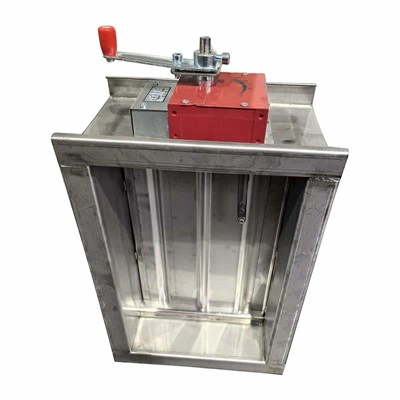
Micro-perforated plate silencers, with their advantages of fiber-free sound-absorbing materials, stable structure, and strong weather resistance, are widely used in HVAC, gas turbines, and various industrial ventilation systems. However, to achieve ideal noise reduction effects and ensure long-term stable operation, in addition to proper selection and matching, mastering scientific installation and usage techniques is essential.
First, correct selection is fundamental. During the engineering design phase, the target noise reduction frequency band should be determined based on the noise spectrum characteristics. Micro-perforated plate silencers perform excellently in the mid-to-high frequency range, but if low-frequency noise needs to be addressed, the resonance absorption characteristics should be optimized by adjusting the plate thickness, aperture, and cavity depth. When selecting a silencer, the system airflow, air velocity, and allowable pressure loss must be calculated to avoid regenerated noise or structural vibration caused by excessive flow velocity.
The installation process directly affects the silencing efficiency. Ensure that the silencer is installed coaxially with the duct, and use elastic gaskets to seal the flange connections to prevent acoustic short circuits caused by misalignment or air leakage. Vibration damping measures should be taken during hoisting to avoid rigid connections transmitting vibration noise. If installed outdoors or in humid environments, attention must be paid to corrosion protection and drainage slope design to prevent condensation buildup from corroding the micro-perforated plate or reducing the perforation rate.
Maintenance during operation is equally crucial. Regularly check the sealing of flange interfaces and promptly clean dust particles adhering to the plate surface to prevent channel blockage and high-frequency failure. For high-dust conditions, it is recommended to install a pre-filter upstream of the silencer. It is worth noting that micro-perforated plate silencers should not be frequently subjected to instantaneous high-pressure airflow impacts, otherwise it may cause plate surface dents or perforation deformation, affecting acoustic performance.
Airflow organization optimization is an advanced technique for improving performance. When conditions permit, an impedance composite arrangement can be used, connecting the micro-perforated plate silencer in series with other types of silencers to broaden the effective noise reduction bandwidth. For large airflow systems, consider installing multiple small silencers in sections instead of a single large device to improve airflow uniformity and reduce overall resistance. Furthermore, properly setting guide vanes can reduce eddy current generation and suppress regenerated noise at its source. Applications in special environments require targeted adjustments. In high-temperature flue gas environments, heat-resistant steel should be selected, and sufficient cavity insulation distance should be maintained. In corrosive gas environments, the plate coating process needs to be upgraded, and the maintenance cycle shortened. During winter operation, attention should be paid to anti-freezing measures to avoid damage to the micro-perforated structure due to ice expansion.
In summary, the effectiveness of micro-perforated plate silencers depends on a comprehensive approach that includes accurate selection, standardized installation, proper maintenance, and adaptation to operating conditions. Engineers should combine the specific characteristics of the sound source with system parameters and flexibly apply the above techniques to achieve stable and efficient noise control in complex environments.